


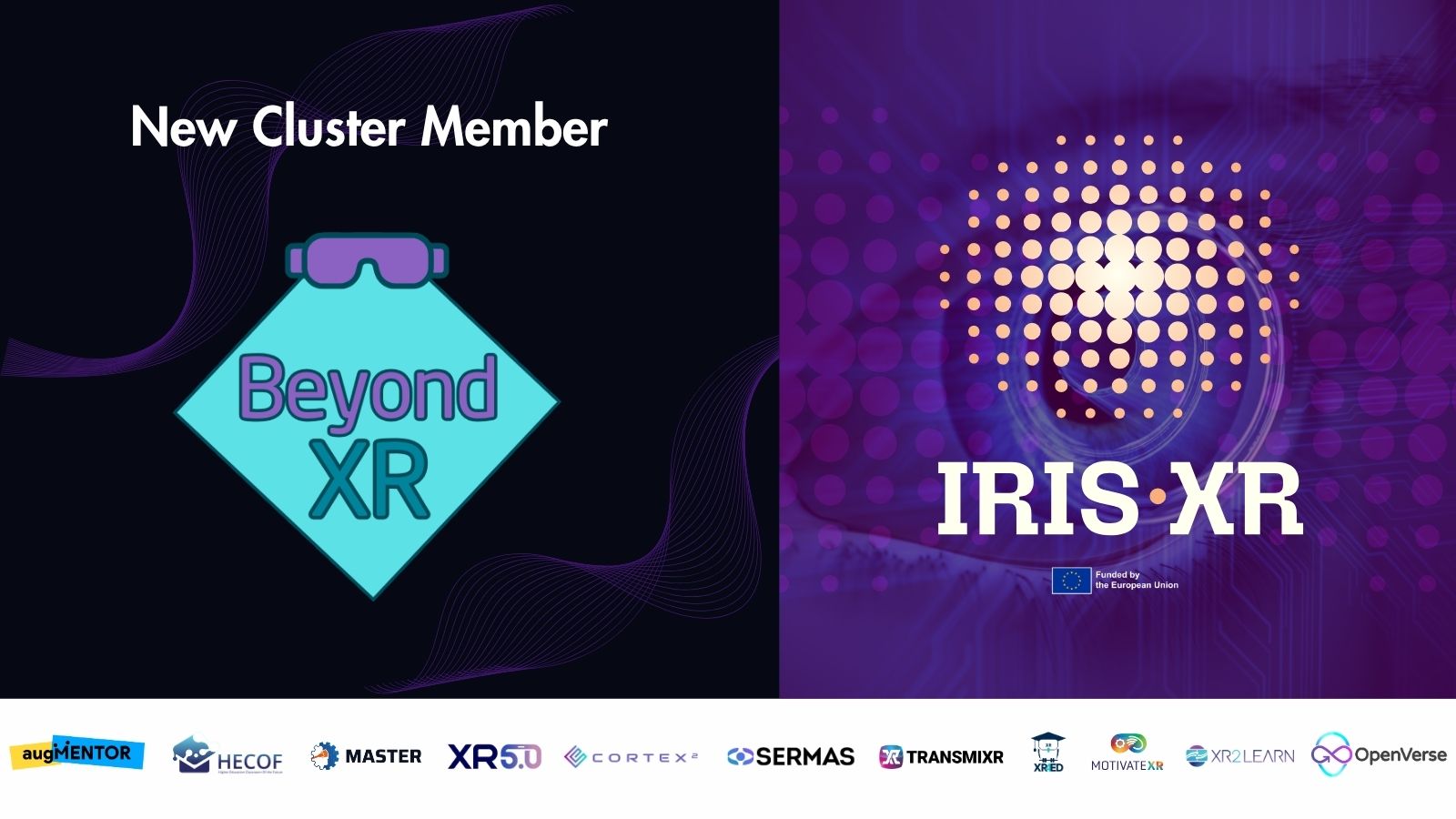
IRIS-XR joins forces with European XR projects through the BeyondXR Cluster
Press Release, 22.09.2026
IRIS-XR has joined the BeyondXR Cluster, connecting the Horizon Europe project with a growing community of European research and innovation initiatives working together to advance the next generation of Extended Reality (XR) technologies and applications.
The BeyondXR Cluster brings together a group of pioneering EU research and innovation projects. The cluster aims to reshape learning and training by integrating advanced technologies such as Extended Reality (XR), Artificial Intelligence (AI), robotics, and immersive technologies into transformative educational solutions, and to address broader applications of XR and emerging technologies, including cross-industry collaboration, immersive media, manufacturing innovation, creative and cultural advancements, and the social acceptance of XR systems.
By fostering synergies among projects, BeyondXR seeks to revolutionize not only learning but also how XR and AI technologies are applied across various sectors to drive innovation and societal impact.
Bringing IRIS-XR expertise to the European XR ecosystem
Launched in June 2026, IRIS-XR brings together eight partners from five European countries to develop an integrated XR hardware-software platform combining advanced displays, embedded eye tracking, event-based sensing and AI-powered multimodal interaction. The technologies will be validated in three real-world areas: healthcare, aviation and automotive design.
Within the BeyondXR Cluster, IRIS-XR will exchange expertise in addressing some of today’s key XR challenges, including visual realism, interaction latency, energy efficiency, accessibility and user trust. Its strong focus on human-centred XR, trustworthy AI, privacy and safety, together with its work on interoperability and standardisation, provides opportunities for knowledge exchange and collaboration with other European XR projects.
“Building strong connections across the European XR ecosystem is essential to maximise the impact of our work. Joining the BeyondXR Cluster gives IRIS-XR a valuable opportunity to create synergies with complementary initiatives, exchange knowledge and best practices, engage with a wider community of stakeholders, and explore new opportunities for collaboration that can extend the project’s reach and impact.”
Carmen Serna, IRIS-XR Communication Manager and Innovation Manager at AUSTRALO
Collaboration within the cluster will also help participating projects explore common technological and societal challenges, identify potential synergies and increase the visibility and impact of European research in XR and immersive technologies.
Discover the vision behind IRIS-XR
To learn more about the project, Dr Alain Pagani, IRIS-XR Project Coordinator and Deputy Director at DFKI, shares the vision behind IRIS-XR in a dedicated interview. He explains how XR works today and discusses the project’s goals and ambitions, the limitations it aims to overcome, the challenges ahead and its expected impact. The interview offers a closer look at how IRIS-XR intends to make future XR experiences more realistic, responsive, intuitive and accessible.
IRIS-XR at a glance
- Development of a next-generation XR hardware-software platform.
- Advanced XR display technologies for enhanced visual quality and lower energy consumption.
- Integrated eye tracking and event-based sensing for natural interaction.
- AI-powered multimodal interaction that combines gaze, gestures, and contextual information.
- Validation in healthcare, flight simulation, and automotive design environments.
- Strong focus on accessibility, ethics, privacy, and trustworthy AI.
- Contributions to European interoperability and standardisation initiatives.
Project partners: DEUTSCHES FORSCHUNGSZENTRUM FUR KUNSTLICHE INTDE (Coordinator), VARJO TECHNOLOGIES, VOXELSENSORS, INSTITUTO TECNOLOGICO DE INFORMATICA, Reiser Simulation and Training, MERCEDES-BENZ AG, UNIVERSITY COLLEGE DUBLIN, AUSTRALO
Follow our journey: LinkedIn | BlueSky | YouTube | X | Newsletter
Funding note:
This project has received funding from the European Union’s Horizon Europe research and innovation programme under grant agreement N° 101298672.
Media contact:
Carmen Serna
Project & Innovation Manager, AUSTRALO

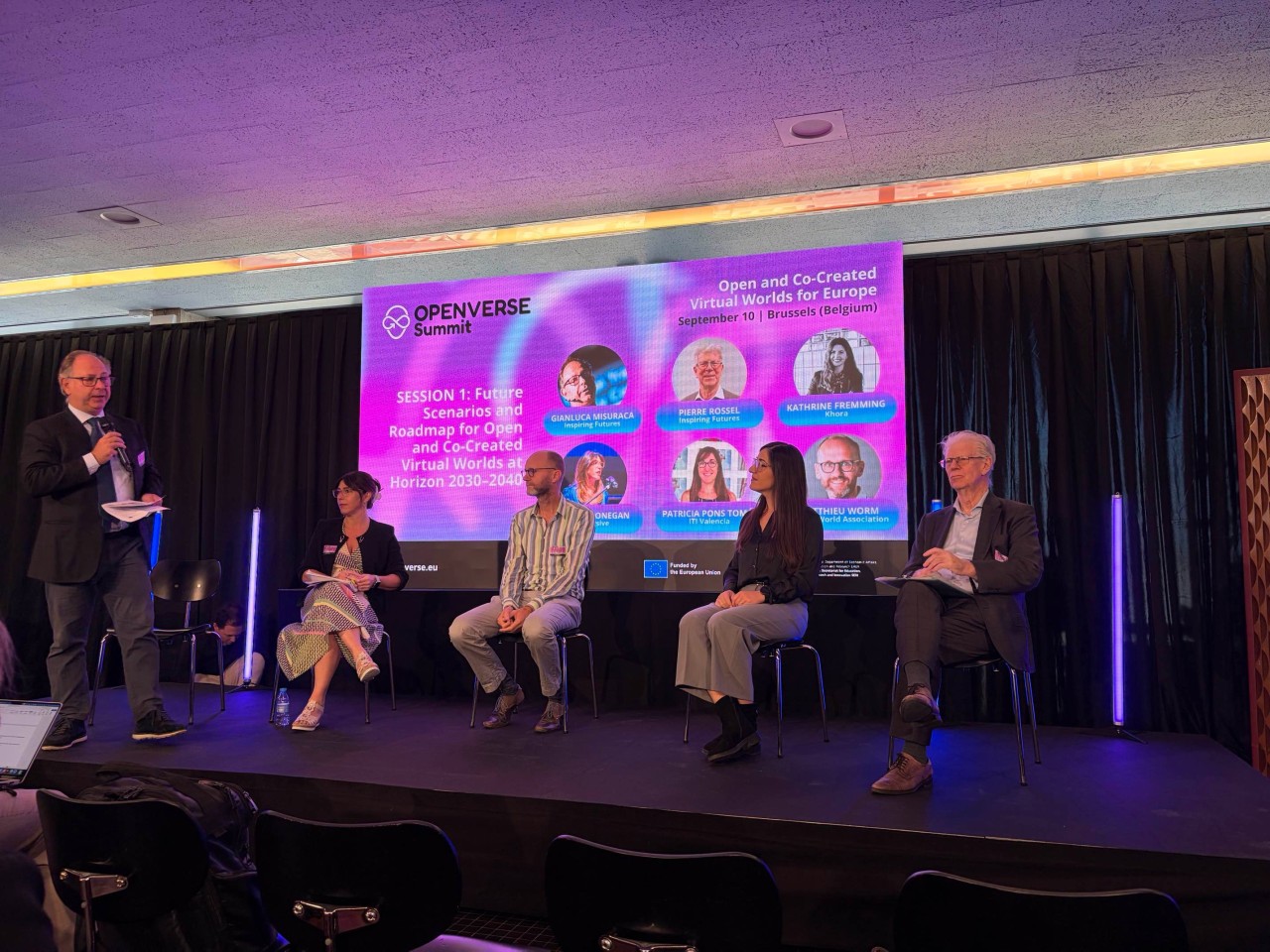
The Human Side of Future Virtual Worlds - IRIS-XR at the OPENVERSE Summit
On 10 September 2026, Patricia Pons Tomás from ITI, an IRIS-XR project partner, participated in the OPENVERSE Summit 2026, contributing to a roundtable on the future of European Virtual Worlds and the Web 4.0 roadmap.
The discussion focused on the research, innovation and policy priorities needed to develop human-centric, trustworthy and sustainable immersive ecosystems, drawing on key priorities identified by the OPENVERSE project.
Designing XR around people
Patricia's contribution focused on the human side of immersive technologies. Next-generation XR systems increasingly use technologies such as eye tracking, gesture tracking and affective sensing, creating new possibilities for more responsive and personalised experiences. At the same time, their development requires careful consideration of trust, safety, wellbeing and accessibility across different users and contexts.
She also shared perspectives from work in sensitive application areas, particularly mental health, where ethical design, inclusivity, and user empowerment are especially important. Looking ahead to the next generation of human-centred XR, Patricia emphasised::
"The future of XR lies in empathic, adaptive systems built through active co-design. We must move beyond viewing users merely as consumers and actively involve them as co-creators of XR experiences. Through participatory design and by evaluating users' real-time emotional and cognitive responses when using an immersive system, we lay the groundwork for intuitive technologies that adapt to the diverse physical and cognitive needs of everyone, from specialized workers to patients."
Connecting the discussion with IRIS-XR
These topics are closely linked to the objectives of IRIS-XR, which is developing new hardware, sensing and AI technologies for next-generation extended reality. Our project explores solutions including display-embedded infrared eye tracking, event-based sensing and AI-driven multimodal fusion, while considering how XR technologies can better respond to users and their needs.
Join our journey!
Subscribe to our newsletter and follow us on LinkedIn, BlueSky, YouTube and X to keep up to date!