


The technology behind IRIS-XR
The technology behind IRIS-XR
IRIS-XR combines breakthrough advances in displays,sensing technologies, and AI-driven interaction to createmore immersive, responsive, and human-centred XRexperiences
Shaping the Future of XR


Advanced XR Display Technology
Visual quality is a fundamental requirement for professional XR applications. However, current display technologies often suffer from limited contrast, visible artefacts, reduced colour fidelity, and high power consumption.
IRIS-XR is developing a new generation of XR displays based on advanced mini/micro-LED backlight technology with intelligent local dimming capabilities. This approach significantly improves visual realism while reducing energy consumption and enhancing user comfort during extended sessions.

Ultra-Fast Eye and Gesture Tracking
Interaction is at the heart of every immersive experience. Yet existing XR systems often struggle with latency, environmental sensitivity, limited accuracy, and high power requirements.
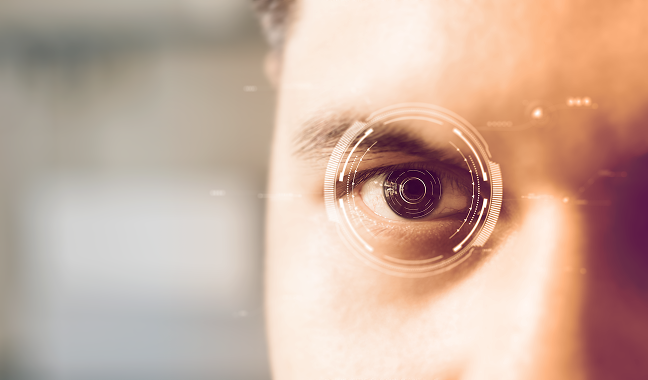
IRIS-XR introduces a novel sensing architecture based on SPAES (Single Photon Active Event Sensing) technology and display-integrated near-infrared (NIR) illumination. By embedding NIR LEDs directly into the display, the system delivers enhanced illumination within a smaller form factor, improving eye-tracking accuracy while reducing optical complexity. Combined with event-driven sensing, this approach captures only relevant information, dramatically increasing efficiency and responsiveness.


AI-Driven Multimodal Interaction
Most current XR systems process eye movements, gestures, and spatial information separately, limiting their ability to adapt dynamically to users and environments.
IRIS-XR develops an advanced AI-driven interaction framework capable of fusing gaze, gesture, and depth information in real time. This multimodal approach creates a more natural, robust, and personalised interaction model.
Human-centred and trustworthy XR
Beyond technological excellence, IRIS-XR places strong emphasis on ethics, inclusiveness, accessibility, privacy, and user trust.
Three innovation pillars.
One integrated XR ecosystem.
- Mini/Micro-LED Backlights
- Enhanced Contrast
- Reduced Halo Effects
- Lower Energy Consumption
- Greater Visual Comfort
- SPAES Event-Based Sensors
- Ultra-Fast Eye Tracking
- Gesture Recognition
- Sub-10 ms Latency
- Outdoor Robustness
- AI Multimodal Fusion
- Real-Time Adaptation
- Drift Compensation
- Personalised Experiences
- Privacy-Preserving AI
From Innovation to Impact
The technologies developed within IRIS-XR will be validated through three real-world pilots in mental healthcare, aviation training, and automotive design. These demonstrations will showcase how advanced XR technologies can improve accessibility, performance, safety, and collaboration across diverse professional and societal domains.